
CerebroMachines Lab
Biomimetic Drug Delivery Systems for Brain / Organ-on-Chip
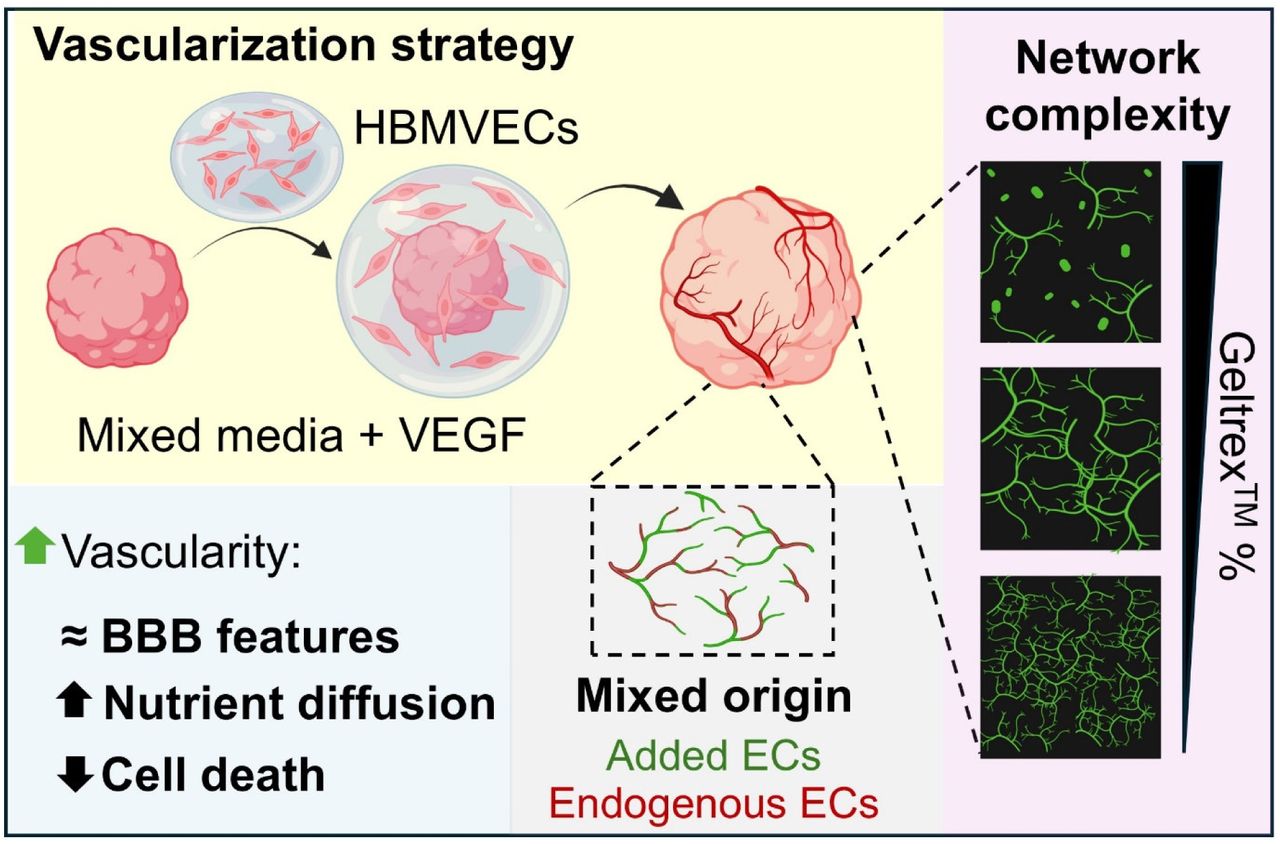
Abstract: Cerebral organoids (COs) are multicellular, self-organized, in vitro, 3D brain-like tissues used for developmental biology, disease modelling and drug screening. However, their lack of vascularity renders them less physiologically accurate. Vascularization of COs remains challenging due to the different requirements between COs and vascular cells, limited vascular network penetration within the organoid, and the absence of luminal perfusion. Here, we devised an encapsulation approach in which human brain microvascular endothelial cells (HBMVECs) were delivered to developing COs from progressively degrading extracellular matrix (ECM)-based hydrogel droplets. By tuning this hydrogel concentration and media composition, we observed enhanced vascular-like network formation that expanded within the organoid tissue. Using pathway inhibitors, we showed that a subset of the endothelial cells (ECs) originated from the CO itself, promoting network integration. Endothelial networks displayed blood-brain barrier (BBB) features, including astrocytic end-footlike interactions, pericyte wrapping, and collagen-laminin basal lamina. Vascularized COs exhibited greater media internalization and up to three-fold lower apoptosis than non-vascularized COs. This comprehensive 3D neurovascular model is a promising platform for cerebrovascular research and drug testing applications.
Key Publications
Fumadó Navarro J., Crilly S., Chan W. K., Browne S., Mason J. O., Giraldo C. V., Pandit A., Lomora M.
Advanced Science, 2025 DOI: 10.1002/advs.202507256
BioRxiv DOI: 10.1101/2025.04.23.650161 )
Using atorvastatin-induced vascular weakness to model brain haemorrhage in vascularised cerebral organoids
Abstract: Intracerebral haemorrhage is the most severe subtype of stroke; however, pre-clinical investigation often fails to translate to the clinic. Cerebral organoids offer an adaptable, in vitro model of human brain tissue for pre-clinical investigation of disease. We recently demonstrated that the tissue can be successfully vascularised to mimic the cerebrovasculature.
Cerebrovascular weakness was induced with atorvastatin to mimic damage observed in intracerebral haemorrhage and to replicate the disease’s pathological features. We used atorvastatin to disrupt functional morphology in human brain microvascular endothelial cells in 2D and 3D model systems. Whole human blood was added to initiate damage to cerebral tissues.
Vascularised cerebral organoids exhibited loss of vascular integrity when treated with atorvastatin. Tissue was vulnerable to injury from human whole blood, and an innate immune response was initiated, resulting in increased cell death.
Here we show that vascularised cerebral organoids demonstrate a novel model platform for investigating pathology associated with human whole blood insult in intracerebral haemorrhage.


Siobhan Crilly, Sugunapriyadharshini Sundararaman, Michael J. Haley, Elisa Segantin, Nicola Campbell, Eulalie J. Lafarge, Antonn Cheeseman, Josep Fumadó Navarro, Declan McKernan, Kevin N. Couper, Mihai Lomora
Under review with Scientific Reports
BioRxiv preprint, 2026 DOI: https://doi.org/10.64898/2026.04.20.719465
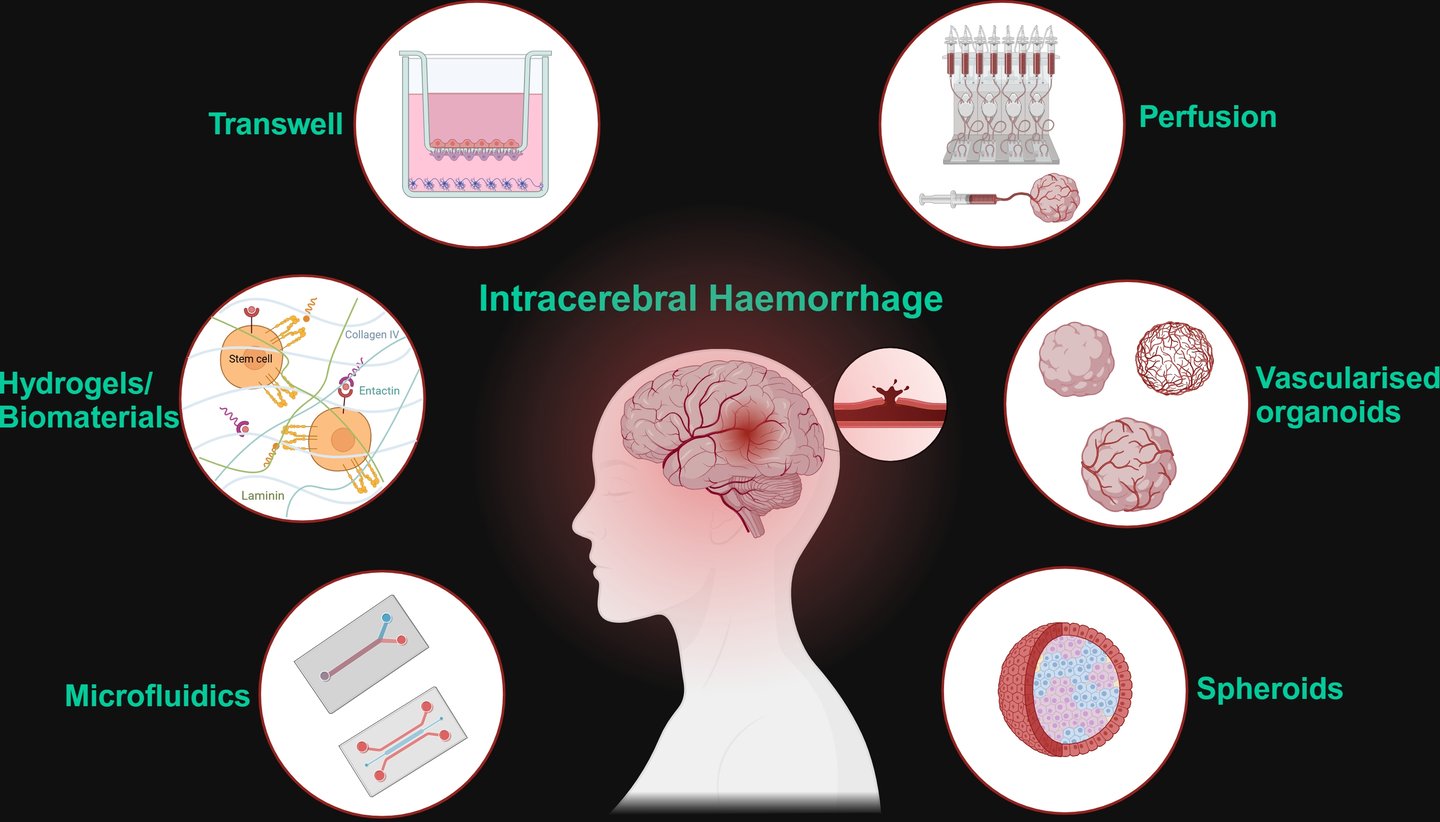
Abstract: Haemorrhagic stroke continues to be a leading cause of death and disability globally, with limited treatment options. Pre-clinical models must adapt to offer translationally relevant and physiologically accurate alternatives to animals. The development of complex co-culture blood-brain barrier models and the incorporation of hydrogels and biomaterials has resulted in microphysical 3D platforms for interrogating drug transport and immune cell transcytosis, however with limited application to haemorrhagic stroke research. Cerebral organoids have revolutionised neuroscience, and novel strategies of vascularising and perfusing them offer a wholly human model system of the cerebrovasculature for the first time. With some adaptation, intracerebral haemorrhage research can benefit from these models for elucidating pathology and recovery mechanisms that can be exploited therapeutically.
Crilly S., Lomora M.
KeAi: Bioactive Materials, 2026 DOI: https://doi.org/10.1016/j.bioactmat.2025.10.018
The Barley Malting Microbiome: Influence on Malt Quality, Control and Characterization Methods
Publications from group members
Steven Kasozi Galiwango, Elif Göksu Kızılyar, Gert De Rouck, Ilse Van de Voorde, Florian Weiland
Brewing Science, 2024. DOI: 10.23763/BrSc24-06galiwango
Fumadó Navarro J., Crilly S., Chan W. K., Browne S., Mason J. O., Giraldo C. V., Pandit A., Lomora M.
Advanced Science, 2025 DOI: 10.1002/advs.202507256
BioRxiv DOI: 10.1101/2025.04.23.650161 )
Lomora M., Larrañaga A., Rodriguez-Emmenegger C., Rodriguez B. J., Dinu I.A., Sarasua J.-R., Pandit A.
Cell Reports Physical Science, 2021. DOI: 10.1016/j.xcrp.2021.100373
Huo Z., Lomora M, Kym U., Palivan C., Holland-Cunz S. G., Gros S. J.
Frontiers in Cell and Developmental Biology, 2021. DOI: 10.3389/fcell.2021.605272
Ucar B., Kajtez J., Foidl B. M., Eigel D., Werner C., Long K.R., Emnéus J., Bizeau J., Lomora M., Pandit A., Newland B., Humpel C.
Acta Biomaterialia, 2021. DOI: 10.1016/j.actbio.2020.11.035
Lomora M., Shumate D., Rahman A. A., Pandit A.
Advanced Therapeutics, 2019. DOI: 10.1002/adtp.201800099
Dinu I. A., Dinu M. V., Lomora M., Palivan C. G., Meier W.
in Smart Materials: Integrated Design, Engineering Approaches, and Potential Applications 2018. Apple Academic Press, Eds: Anca Filimon DOI: 10.1201/9781351167963
Larrañaga A., Isa I. L. M., Patil V., Thamboo S., Lomora M., Fernández-Yague M. Y., Sarasua J-R., Palivan C. G., Pandit A.
Acta Biomaterialia, 2018. DOI: 10.1016/j.actbio.2017.12.014
Larrañaga A., Lomora M., Sarasua J.R., Palivan C.G., Pandit A.
Progress in Materials Science, 2017. DOI: 10.1016/j.pmatsci.2017.08.002
Lomora M., Gunkel-Grabole G., Mantri S., Palivan C.G.
Chemical Communications, 2017. DOI: 10.1039/C7CC04739H
Garni M., Einfalt T., Lomora M., Car A., Meier W., Palivan C. G.
Chimia, 2016. DOI: 10.2533/chimia.2016.424
Zhang X., Lomora M., Einfalt T., Meier W., Klein N., Schneider D., Palivan C. G.
Biomaterials, 2016. DOI: 10.1016/j.biomaterials.2016.02.042
Postupalenko V., Einfalt T., Lomora M., Dinu I. A., Palivan C. G.
in Organic Nanoreactors: From Molecular to Supramolecular Organic Compounds, 2016. Academic Press, Eds: Samahe Sadjadi. DOI: 10.1016/B978-0-12-801713-5.00011-2
Lomora M., Dinu I.A., Itel F., Rigo S., Spulber M., Palivan C.G.
Macromolecular Rapid Communications, 2015. DOI: 10.1002/marc.201500289
Lomora M., Itel F., Dinu I.A., Palivan C.G.
Physical Chemistry Chemical Physics, 2015. DOI: 10.1039/C4CP05879H
Gunkel-Grabole G., Sigg S., Lomora M., Lörcher S., Palivan C. G., Meier W. P.
Biomaterials Science, 2015. DOI: 10.1039/C4BM00230J
Lomora M., Itel F., Dinu I.A., Palivan C.G.
Biomaterials, 2015. DOI: 10.1016/j.biomaterials.2015.02.080
Hematoma Interleukin‐1 Receptor Antagonist Concentrations Predict Long‐Term Outcome in Acute Human Intracerebral Hemorrhage
Parry‐Jones, Adrian R., Blessing Nyakutsikwa, Michael H. Askenase, Matthew Gittins, Mary Newland, Siobhan Crilly, Paul R. Kasher et al.
Annals of Neurology, 2026. DOI: https://doi.org/10.1002/ana.78237
Victor S Tapia, Sarah E Withers, Ran Zhou, Abigail Bennington, Christopher Hoyle, Frances Hedley, Adam El Khouja, Nadim Luka, Marco Massimo, Siobhan Crilly, Katherine R Long, Catherine B Lawrence, Paul R Kasher
Disease Models & Mechanisms, 2025. DOI: https://doi.org/10.1242/dmm.052145
The role of 25-hydroxycholesterol in the pathophysiology of brain vessel dysfunction associated with infection and cholesterol dysregulation
Loss of col4a1 in zebrafish recapitulates the cerebrovascular phenotypes associated with monogenic cerebral small vessel disease
Flatman, Daisy, Richard W. Naylor, Siobhan Crilly, Isabel Carter, Aleksandr Mironov, Emmanuel Pinteaux, Stuart M. Allan, Rachel Lennon, and Paul R. Kasher.
Matrix Biology, 2025. DOI: 10.1016/j.matbio.2025.08.005
Siobhan Crilly, Marietta Zille, Paul R Kasher, Michel Modo
Frontiers in Neurology, 2023. DOI: https://doi.org/10.3389/fneur.2023.1266075
Innovative models of stroke pathology
Investigating recovery after a spontaneous intracerebral haemorrhage in zebrafish larvae
Siobhan Crilly, Isabel Shand, Abigail Bennington, Emily McMahon, Daisy Flatman, Victor S Tapia, Paul R Kasher
Brain Communications, 2024. DOI: https://doi.org/10.1093/braincomms/fcae310
OS Qureshi, TF Rowley, F Junker, SJ Peters, S Crilly, J Compson, A Eddleston, H Björkelund, K Greenslade, M Parkinson, NL Davies, R Griffin, TL Pither, K Cain, L Christodoulou, L Staelens, E Ward, J Tibbitts, A Kiessling, B Smith, FR Brennan, M Malmqvist, F Fallah-Arani, DP Humphreys
Scientific Reports, 2017. DOI: https://doi.org/10.1038/s41598-017-17255-8
Multivalent Fcγ-receptor engagement by a hexameric Fc-fusion protein triggers Fcγ-receptor internalisation and modulation of Fcγ-receptor functions
Identifying applications of virtual reality to benefit the stroke translational pipeline
Matan Bone, Maham Malik, Siobhan Crilly
Brain and Neuroscience Advances, 2023. DOI: https://doi.org/10.1177/23982128231182506
Characterization of a mutant samhd1 zebrafish model implicates dysregulation of cholesterol biosynthesis in Aicardi-Goutières syndrome
Sarah E Withers, Charlie F Rowlands, Victor S Tapia, Frances Hedley, Ioana-Emilia Mosneag, Siobhan Crilly, Gillian I Rice, Andrew P Badrock, Andrew Hayes, Stuart M Allan, Tracy A Briggs, Paul R Kasher
Frontiers in immunology, 2023. DOI: https://doi.org/10.3389/fimmu.2023.1100967
Zebrafish for modeling stroke and their applicability for drug discovery and development
Siobhan Crilly, Emily McMahon, Paul R Kasher
Expert Opinion on Drug Discovery, 2022. DOI: 10.1080/17460441.2022.2072828
Zebrafish drug screening identifies candidate therapies for neuroprotection after spontaneous intracerebral haemorrhage
Siobhan Crilly, Adrian Parry-Jones, Xia Wang, Julian N Selley, James Cook, Victor S Tapia, Craig S Anderson, Stuart M Allan, Paul R Kasher
Disease Models and Mechanisms, 2022. DOI: https://doi.org/10.1242/dmm.049227
RNA-Seq Dataset From Isolated Leukocytes Following Spontaneous Intracerebral Hemorrhage in Zebrafish Larvae
Siobhan Crilly, James Cooper, Lauren Bradford, Ian E Prise, Siddharth Krishnan, Paul R Kasher
Frontiers in cellular neuroscience, 2021. DOI: https://doi.org/10.3389/fncel.2021.660732
Impaired eIF5A function causes a Mendelian disorder that is partially rescued in model systems by spermidine
Víctor Faundes, Martin D Jennings, Siobhan Crilly, Sarah Legraie, Sarah E Withers, Sara Cuvertino, Sally J Davies, Andrew GL Douglas, Andrew E Fry, Victoria Harrison, Jeanne Amiel, Daphné Lehalle, William G Newman, Patricia Newkirk, Judith Ranells, Miranda Splitt, Laura A Cross, Carol J Saunders, Bonnie R Sullivan, Jorge L Granadillo, Christopher T Gordon, Paul R Kasher, Graham D Pavitt, Siddharth Banka
Nature communications, 2021. DOI: https://doi.org/10.1038/s41467-021-21053-2
Revisiting promising preclinical intracerebral hemorrhage studies to highlight repurposable drugs for translation
Siobhan Crilly, Sarah E Withers, Stuart M Allan, Adrian R Parry-Jones, Paul R Kasher
International Journal of Stroke, 2021. DOI: https://doi.org/10.1177/1747493020972240
Analysis of U8 snoRNA variants in zebrafish reveals how bi-allelic variants cause leukoencephalopathy with calcifications and cysts
Andrew P Badrock, Carolina Uggenti, Ludivine Wacheul, Siobhan Crilly, Emma M Jenkinson, Gillian I Rice, Paul R Kasher, Denis LJ Lafontaine, Yanick J Crow, Raymond T O’Keefe
The American Journal of Human Genetics, 2020. DOI: 10.1016/j.ajhg.2020.04.003
Using zebrafish larvae to study the pathological consequences of hemorrhagic stroke
Siobhan Crilly, Alexandra Njegic, Adrian R Parry-Jones, Stuart M Allan, Paul R Kasher
Journal of Visualised Experiments (JoVE), 2019. DOI: 10.3791/59716
Using zebrafish larval models to study brain injury, locomotor and neuroinflammatory outcomes following intracerebral haemorrhage
Siobhan Crilly, Alexandra Njegic, Sarah E Laurie, Elisavet Fotiou, Georgina Hudson, Jack Barrington, Kirsty Webb, Helen L Young, Andrew P Badrock, Adam Hurlstone, Jack Rivers-Auty, Adrian R Parry-Jones, Stuart M Allan, Paul R Kasher
F1000 Research, 2018. DOI: 10.12688/f1000research.16473.2
Zeinabad A.H.A, Yeoh W.J., Arif M., Lomora M., Banz Y., Riether C., Krebs P., Szegezdi E.
Biomaterials, 2023. DOI: 10.1016/j.biomaterials.2023.122126
Developing an in vitro model of haematoma for study of intracerebral haemorrhage
Siobhan Crilly, Victor Sebastian Tapia, Carlo Bawn, Annalisa Tirella
Biomaterials Science, 2024. DOI: https://doi.org/10.1039/d4bm00039k
© 2026. CerebroMachinesLab. All rights reserved.